Zum Hauptinhalt springen

THE WAY OF WRITING

Seven hundred years of calligraphic art between East and West

Curated by Monica Viero and Monica Dengo

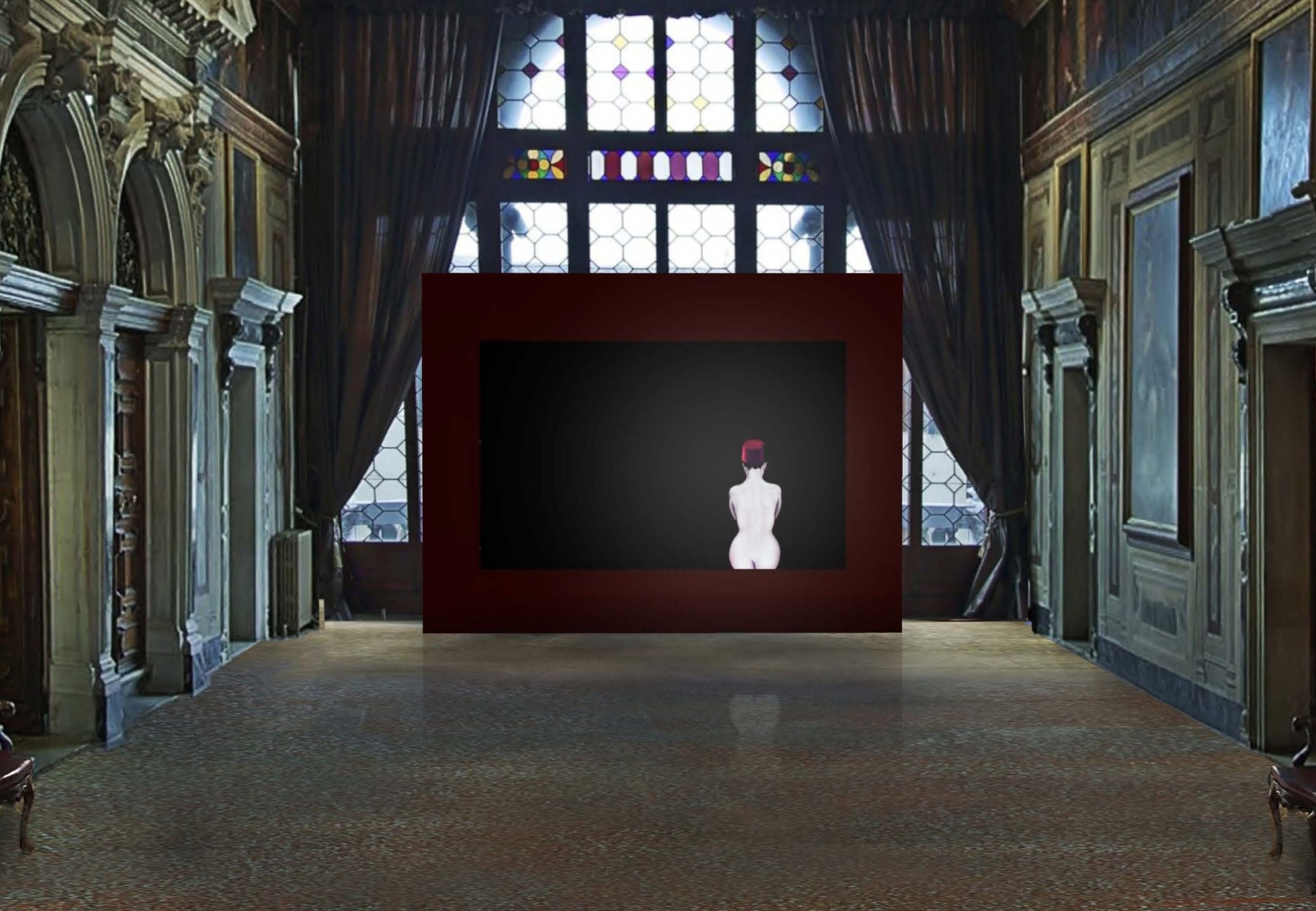
In 2024, the MUVE will continue its firmly established initiatives to promote the knowledge and practice of calligraphy among the general public. The traditional masterclasses organised by the Library of the Museo Correr will be accompanied by an exhibition of works mirroring the calligraphic cultures encountered by Marco Polo on his journey to China.

On display are the works of six contemporary artists from China, Iran, Iraq, Armenia and Italy, as well as a series of ancient documents and manuscripts preserved by the Correr Museum Library in Arabic, Armenian, Chinese and Burmese languages, in a journey in which the Silk Road becomes the Way of Writing.

This path allows us to appreciate the different artistic, historical and cultural declinations of calligraphy. While ancient documents maintain the classical relationship in which form is primarily in the service of content, contemporary artists investigate the communicative power of writing forms in themselves, even rejecting or renouncing semantic content altogether.

Each of the six artists stands in a particular relationship to the calligraphy and handwriting of their country of origin, investigating what the forms convey as symbols, shapes in space, or signs and maintaining a relationship of cultural identification with their origins.
Works by:

Gayane Yerkanyan’s work often involves decontextualizing Armenian letters to offer new visual and symbolic meanings. In her works, there are no words; the meaning is the letters themselves. As symbols of Armenian cultural heritage, they become visual representations of a culture, combined in abstract plays of form and space.
The artist’s two works in this exhibition have an approach closer to geometric drawing than to the direct and spontaneous sign proper to handwriting. Hers is a mark that is almost devoid of gestures and yet laden with those imprecisions that are characteristic of direct handwork, which does not intend to hide its humanity.

BIOGRAPHY
Gayane Yerkanyan (Yerevan, Armenia, 1989) has been living and working in Amsterdam since 2015. After graduating from the Yerevan Academy of Arts and receiving her master’s degree from the Utrecht School of the Arts in the Netherlands, she worked in graphic design and art. Her work often involves decontextualizing Armenian letters to offer new visual and symbolic meanings. The artist uses the Armenian letter and its variations as a metaphor for the individual trying to define herself both as an individual and as part of society.

In her works Golnaz Fathi combines traditional calligraphy with contemporary artistic expression by stretching the boundaries of the very concept of calligraphy: while maintaining the visual essence of the written word, Fathi writes what she calls non-writings, that is, writings devoid of semantic value and intended to be interpreted not with the eyes but through the heart. The inspiration for the scrolls in this exhibition comes from the poetry of Jalal al-Din Rumi (1207-1273). Each scroll is reminiscent of a litany, a haunting repetition of forms that we would like to read but cannot just as the artist cannot read them, despite having had Rumi’s poem in mind as she wrote them. These non writings seem to be a negation of codified language, the paradoxical image of the impossible attempt at a real communication of being.

BIOGRAPHY
Golnaz Fathi (Tehran, Iran, 1972) graduated in calligraphy from the Calligraphy Association of Iran in 1996, a year after graduating in Graphic Design from Tehran’s Azad Art University in 1995. In the same year she received an award as the best female calligrapher, one of the few artists to have studied calligraphy in Iran at such a high level.
In her works, Fathi transfers the forms of Persian writing into a personal and abstract artistic language. As an Iranian woman artist in a fragmented and disassociated modern world, Fathi began to pursue abstract impulses early on and to write texts that cannot be deciphered but are charged with the emotions and feelings that the forms of writing themselves convey.

Hassan Massoudy blends the essences of the contemporary and the historical by interweaving elements of Eastern and Western artistic traditions.
While maintaining the legacy of tradition, he simultaneously breaks away from its boundaries, promoting an evolution of writing forms. Inspirations for his compositions are drawn from a wide range of sources, ranging from the verses of poets to the prose of writers from different cultures to the eternal wisdom of folk sayings. Each trait in his work reflects his unwavering commitment to exploring the nuances of human experience through art.

BIOGRAPHY
Hassan Massoudy (Najaf, Iraq, 1944) studied classical calligraphy in Baghdad and has lived in France since 1969 where he pursued art studies at the École Nationale Supérieure des Beaux-Arts in Paris. Massoudy writes large letters in bright colors on paper or canvas to create works that bring traditional Arabic script into a contemporary context. Inspired by Eastern and Western authors, poets and philosophers, he draws the viewer’s attention to the sculptural dimensionality and aesthetic wonder of both the letter form and the process of tracing it on paper. His works are legible, and the author claims that legibility is an element of essential importance in his work. Massoudy has become an important reference point for artists who call themselves calligraffiti. Street artist El Seed, who uses calligraphy in his art, said the work of Iraqi painter Hassan Massoudy was a major source of inspiration for him: „Massoudy’s work was totally different from anything I had seen before, from the shapes of the letters to the use of color. He completely revolutionized the art of calligraphy.“

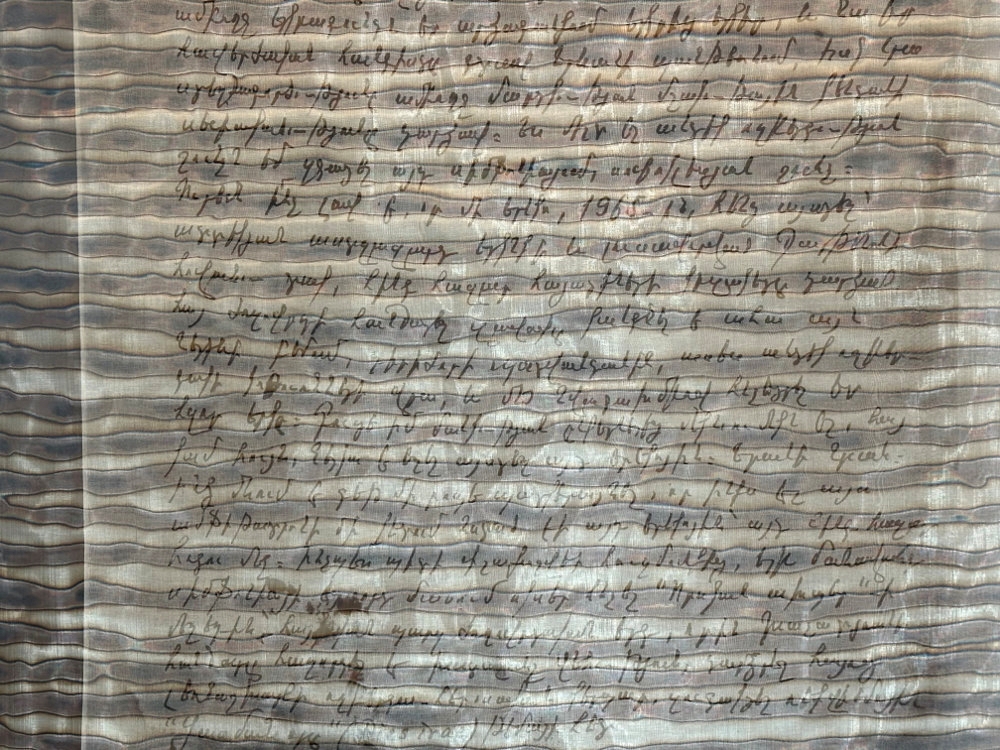
Sarko Meené reflects on the exploration of meanings related to memory, handwriting and Armenian letters through the manuscripts of her grandfather, writer and poet Karpis Surenyan and specifically through her book ‘The Mystery of being Armenian’: „I am fascinated by the heavily edited and crossed out pages. Using the concept of layers, I integrate my grandfather’s text as a fundamental layer with a wire mesh as a secondary layer, creating depth and allowing light to penetrate through the layers of matter.
Symbolically, the stainless steel layer represents protection, as I myself, who identify with such a layer, stand in defense of my grandfather’s legacy. The deceptive appearance of the wire mesh, initially resembling silk, emphasizes themes of femininity and strength. These layers represent various aspects of life and are a reflection of the continuity between past, present and future”.

BIOGRAPHY
Sarko Meené (stage name of Armine Sarkavagyan, Yerevan, Armenia, 1984), after a bachelor’s degree in arts in the USA, has been living and working permanently in Armenia since 2011. After a career as a professional tennis player and a degree in Master of Arts and Philosophy, she returned in 2008 to Armenia where she devoted herself completely to art. Her works focus on Armenian memory and in particular on the work of her grandfather, writer Karpis Surenyan whose handwritten letters Sarko uses.

Mingjun Luo mainly explores the concepts of identity and memory. Divided between Chinese and Swiss cultures, she conceives of her work as a “third space”, a hybrid and fertile ground where she develops her own language, in a continuous movement between Asia and the West.
Her series ‘Break the Character’ contradicts the Chinese tradition by presenting fragmented and decomposed ideograms to the point of abstraction. The deconstruction of Chinese characters and their loss of semantic value causes them to become abstract, while retaining the essence of traditional ink calligraphy. In this way, all observers are on an equal footing in front of the artwork, and the two traditions and cultural identities can find a meeting point and dialogue.
Probing simultaneously her roots and current identity, Mingjun Luo interrogates her relationship with the world, marked by exile. In the circular work ‘Traces of Writing’, which contains the ideograms of the ‘Daodejing’, a fundamental text of Taoism attributed to the Chinese philosopher Laozi, who lived between the 4th and 5th centuries B.C., the artist writes ideograms that seem to disappear in a fog, melting into oblivion. The text, she says, is her response to the traces of history that come and go, false and real, unpredictable.

BIOGRAPHY
Mingjun Luo (Nanchong, China, 1963) studied oil painting at the Hunan Academy of Fine Arts between 1979 and 1983. Passionate about Western history, literature and philosophy, she moved to Switzerland in 1987 where, driven by a deep sense of nostalgia for her native country, she rediscovered ink painting and Chinese calligraphy, which she practiced daily. Fusing Chinese traditions with contemporary Western art forms, she began to deconstruct the strokes of ideograms and rewrite words, achieving abstraction while preserving the authentic essence of writing. In this way, all observers are on an equal footing in front of the artwork, and the two traditions and cultural identities can find a point of encounter and dialogue.

The work entitled ‘To wonder is to go’ explores the concept of “boundless writing”, expressed by the loss of definition of the edges of the letters, which dissolve into the space of the canvas.
By observing the strokes of the boundless writing, one can sense the gestures of the hand that gave birth to those marks, perceive the changes in speed and pressure, as well as the moment when the ink-laden brush touches the surface, generating denser and deeper strokes.
Boundless writing breaks free from the rigidity of the printed page, emerging from its textual cage to explore new expressive and conceptual horizons. The hierarchical organization of the text, with its orderly and rational arrangement, can be seen as a tangible representation of the logical thinking that permeates our contemporary society. However, this structure could also be considered a symptom of the persistent anthropocentric vision that pushes us to consider ourselves as the fulcrum of the universe. From a distance the ‚circular work looks like a flower, as if encroaching beyond the edges, the letters become a single shape. Some of the letters can still be read, coming to  make up the word “MERAVIGLIARSI”. Viewed up close, however, the black marks become more hazy and the word, losing definition, dissolves.

BIOGRAPHY
Monica Dengo (Camposampiero, Padua, Italy, 1966) is an artist, lecturer, curator and organizer of art events. Her main fields of interest are calligraphy, handwriting and markmaking. After attending a calligraphy and bookbinding school in London (1991-1992) and continuing with independent studies in the United States (1993-1998), she began an investigation into the connection people have with their handwriting. Her artistic research focuses on handwriting as a form of expression deeply connected with the wholeness of body and mind. Her work, both as an artist and as a curator, focuses on cross-cultural communication and the relationship people have with the writings of other cultures.

The exhibition, which is part of the calligraphy events The way of writingcurated by Monica Viero – will be accompanied by two workshops of four days each held on the premises of the Scuola del Vetro Abate Zanetti in Murano in October 2024, in collaboration with MUVE Academy. They will include the presence of a teacher of Western calligraphy and teachers of Arabic, Chinese and Tibetan calligraphy. The workshop and exhibition will explore the origins of calligraphic art and the mutual exchanges between East and West.

They will provide an opportunity to study handwriting as artistic expression and a vehicle of knowledge and messages capable of creating a dialogue and establishing an authentic bridge between different cultures.

#MarcoPolo700

Download the exhibition catalogue

Entdecken Sie auch