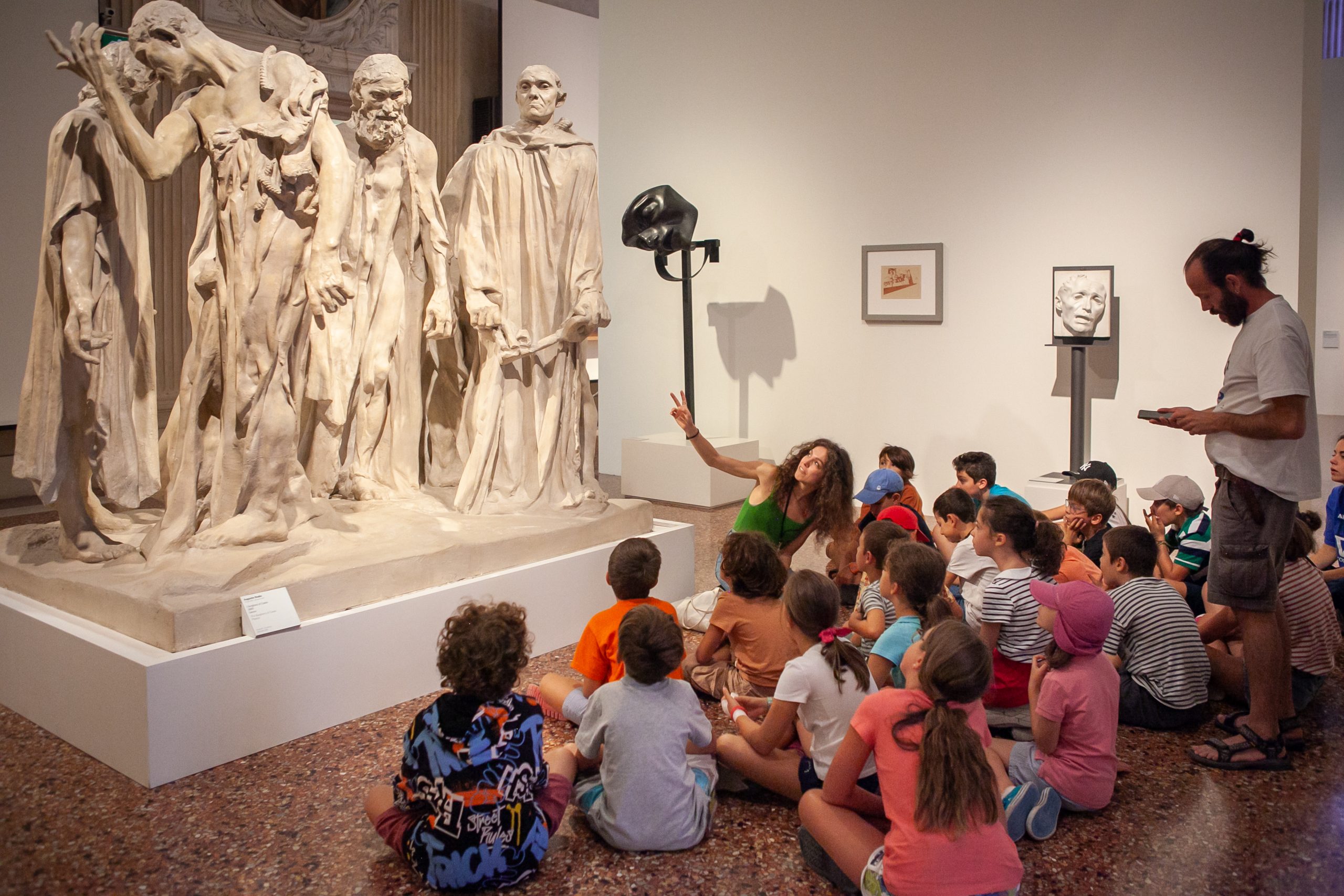
Schools at the Museum
Educational programs
Educational activities carried out in the museum with specialised museum educators, enriched also with specific kits to continue the experience in the classroom or with proposals to learn/improve a foreign language (LS) through integrated learning of content and language, with the CLIL (Content and Language Integrated Learning) methodology.
The activities range from infant school to the Higher Education System (Universities etc.)
Here a full listing of activities.
How to take part an costs >
TEMPORARY EXHIBITIONS
JENNY SAVILLE A CA' PESARO
Venice, Ca’ Pesaro – International Gallery of Modern Art
Until 22 November 2026
Guided tour of the exhibition
In the year of the Art Biennale, this guided tour explores the retrospective that Ca’ Pesaro has dedicated to Jenny Saville (Cambridge, 1970), one of the most important painters of our time, a member of the Young British Artists (YBA). This is the artist’s first exhibition in Venice- A figure who has revitalised contemporary oil painting, the show traces her career from the 1990s to the present day with 30 paintings, including significant major works, among which a series of previously unseen works paying homage to the lagoon city.
Known for her figurative painting, which explores the body and its social implications, her monumental canvases ‘engage in dialogue’ within the museum with the great masters of the past, in particular the Venetian school of painting, in a unique encounter between contemporary art and historical heritage.
TARGET: upper secondary schools, universities
DURATION: 1h
Choose and book →
Klimt, Schiele, Kokoschka and the Body in Contemporary Art
Mestre, Muvec – Casa delle Contemporaneità
3rd-floor exhibition spaces
Until 14 February 2027
Guided tour of the exhibition
The MUVE exhibition programme for the Candiani Cultural Centre continues in the new MUVEC galleries; over the years, drawing on the civic collections of Ca’ Pesaro, it has focused on leading figures of twentieth-century art, including Kandinsky, Chagall, Matisse and Munch. Now on display in Mestre, thanks in part to significant international loans, are the great masters of the Vienna Secession – Gustav Klimt, Egon Schiele and Oskar Kokoschka – whose extraordinary ability to explore the human body gives rise to representations of remarkable intensity, authenticity and profoundly unsettling power.
The exhibition creates a dialogue between Klimt’s refined, seductive and unsettling female figures and Schiele’s austere and tormented bodies, whose artistic exploration reveals deep connections with the emerging theories of psychoanalysis.
Alongside them emerges the visionary personality of Kokoschka, who, through his vibrant, expressive painting, interprets the tensions of an era marked by the most recent avant-garde movements in art, before the dramatic upheaval brought about by the First World War. The theme of the body, understood as a meeting point between flesh and psyche, re-emerges powerfully in the period between the two world wars (Sironi and Casorati), continuing through to the present day amidst the erotic provocation and exhibitionism of the world of images.
TARGET: lower (last year) and upper secondary schools, universities
DURATION: 1h 15min
Choose and book →
Workshop
Telling stories through images
Following a guided tour of the exhibition, during which participants observe and analyse the subjects, the visual language and the use of colour in the lithographs on display, they take part in a creative workshop. Inspired by the works, they experiment with a printing process reminiscent of lithography, but using everyday materials. The activity makes it possible to understand the fundamental principles of the lithographic technique (Kitchen Litho) and to explore the expressive potential of printmaking first-hand.
TARGET: lower (last year) and upper secondary schools, universities
DURATION: 2h
Choose and book →
DOGE'S PALACE
GUIDED TOURS
The Lion Hunt
Who better than a lion – the symbol of Venice – to guide children on an extraordinary journey of discovery through the Palace? The ‘hunt’, which follows the lion’s myriad appearances – in paintings, sculptures and frescoes – reveals unique perspectives and unusual routes, as participants gradually ‘capture’ clues and piece them together to create a fun final surprise to take home. The tour starts in the courtyard and includes a visit to the Palace’s most important rooms, including the State Rooms, with the exception of the Armoury and the Prisons.
>> The activity is also available in Italian Sign Language (LIS).
Target: Nursery schools (older children) and primary school
Duration: 2h
Language: Italian, English, French, Spanish, Russian, German
A perfect Venetian crime. Find the culprit in the Doge’s Palace
A murder that actually occurred in the Doge’s Palace in the mid-15th century serves as the central theme for a guided tour, accompanied by an activity book, which winds its way through the building’s most significant locations: from the courtyard to the State Rooms – including those of the Senate, the Great Council and the Scrutinio – right through to the Bridge of Sighs and the New Prisons. The aim is to discover the numerous clues that shed light on an intricate affair that took place during the rule of Doge Francesco Foscari in the mid-15th century.
Target: primary schools (age 8 – 10) and lower secondary school (only class I and II)
Duration: 2h
Language: Italian, English, French, Spanish
The Doge’s Palace: The Symbol of the City
A dynamic and engaging themed tour introduces visitors to the complexity and extraordinary beauty of this iconic landmark of Venice, formerly the seat of the Doge and the Republic’s magistrates, and the very embodiment of Venetian civilisation over the centuries. To understand better the fundamental aspects of the Palace – from its architectural structure, a masterpiece of Gothic art enriched by Renaissance and Mannerist elements, to its interiors, magnificently decorated by a host of artists, including Titian, Veronese and Tintoretto – the tour is supported by educational materials that illustrate the meanings, symbols and functions of the various institutions of the Republic of Venice, the fundamental role of justice and the splendour of its public image. The tour also includes a brief visit to the Bridge of Sighs and the New Prisons.
Target: Lower and upper secondary school and higher education system (Universities etc.)
Duration: 2h
Language: Italian, English, French, Spanish, Russian, German
WORKSHOPS
A 3D Palace
Designed to be adapted to different age groups, the workshop is preceded by a tour of the building focusing on its structure and history, as well as the construction process through which it became this extraordinary architectural – as well as governmental – centre of the city. In the workshop, pupils use a cardboard ‘exploded view’ as a starting point to create a 3D model of the Palace to take home. The tour begins in the courtyard and includes visits to the most important rooms, including the State Rooms, with the exception of the Armoury and the Prisons.
>> The class is asked to bring a bag or box in which to pack the finished models to take home.
Also available in the Muve Toolkit version: at the end of the tour, the class receives a kit containing 3D cardboard models of the Palace to assemble, along with instructions, a brief museum guide and other materials, enabling pupils to continue the practical activities back at school and consolidate what they have learnt.
In collaboration with Formacultura
Target: primary schools (age 8 – 10), lower and upper secondary school and higher education system (Universities etc.)
Duration: 2h 30 min (2h in toolkit version)
Language: Italian, English, French, Spanish
DOGE'S PALACE & MUSEO CORRER
COMBINED TOURS
From Doges to Emperors
A single itinerary takes participants on a journey of discovery through some of the most important buildings in Venice’s St Mark’s Square: the Doge’s Palace, the heart of the Serenissima, and the nineteenth-century Royal Palace, home to the Correr Museum, situated between the Napoleonic Wing and the Procuratie Nuove. The tour offers a glimpse into the splendour and grandeur of a bygone era, as well as the visible traces of a complex and dramatic historical journey that led from the Republic of Venice through to Napoleonic and subsequently Habsburg rule, whilst preserving a distinctly Italian identity and artistic character.
The tour includes a visit to the most important rooms of the Doge’s Palace, including the State Rooms, with the exception of the Armoury and the Prisons; at the Correr Museum, it takes in the royal apartments of Empress Elisabeth (‘Sissi’) and the Canova Rooms. Here, until 22 November 2026, the tour is complemented by the exhibition Spiral Economy: Charrière and Canova, a reflection on the poetics of time and matter, bringing together works by Canova and installations by the Franco-Swiss artist Julian Charrière.
From autumn 2026 and throughout 2027, the Correr Museum will be undergoing major museographical refurbishment, which may result in changes to visitor routes and the display.
Target: Lower (only class III) and upper secondary school and higher education system (Universities etc.)
Duration: 2h 30 min
Language: Italian, English, French
MUSEO CORRER
GUIDED TOURS
The Art detective
The Museo Correr’s picture gallery – one of the richest and most important collections of Venetian painting from its origins to the early sixteenth century, which includes works by Lorenzo Veneziano, Bellini, Carpaccio, Cosmè Tura, Antonello da Messina and Lorenzo Lotto, presented in an evocati-ve setting by Carlo Scarpa – becomes a ‘playground’.
With the aid of an activity book, story-telling opens the way to the discovery of clues and the resol-ving of puzzles, all of which teach the children how to look at pictures and understand them.
Target: Primary school
Duration: 1h 30 min
Language: Italian, English, French
From autumn 2026 and throughout 2027, the Correr Museum will be undergoing major museographical refurbishment, which may result in changes to visitor routes and the display.
CA' REZZONICO - Museum of Eighteenth-century Venice
GUIDED TOURS
Venice in the eighteenth century
At Ca’ Rezzonico, one of the most opulent Venetian palazzi, eighteenth-century Venice and its aristocracy are illustrated in painting through myths and allegories. Yet a ‘new world’ is already beginning to emerge, portraying reality as it truly appears. The themed tour begins on the ground floor, in the Spazio ’700 – MUVE FOR ALL, where participants can explore a 3D model of the building, accompanied by educational materials and resources, before immersing themselves in the ‘great beauty’ of the paintings of Tiepolo and Longhi, the artistry of sculptors and cabinetmakers such as Brustolon, and the exquisite craftsmanship of furnishings and porcelain. The tour also offers an opportunity to reflect on the crucial importance of the Age of Enlightenment and the various ways in which it can be represented and understood, including through an interdisciplinary approach.
Target: Lower and upper secondary school and higher education system (Universities etc.)
Duration: 1h 30 min
Language: Italian, English, French, Spanish, Russian
WORKSHOPS
A fan from the fabulous Orient
Dragons, rhinoceroses, dogs, camels, but also pagodas and lotus flowers… what stories, symbols and curiosities do these motifs from the mythical East reveal? The activity begins with a ‘hunt’ for these images throughout the museum, followed by a session in the education room, where children decorate a fan inspired by what they have just seen, using stencils and a wide range of colours.
Target: nursery and primary schools
Duration: 2h
Language: Italian, English, French
Easily Venice
A notebook full of riddles serves as a map for a sort of travelling treasure hunt through the rooms of Ca’ Rezzonico, as children discover the symbolic elements of Venice hidden amongst the furnishings, paintings and spaces of the museum. This fun activity, which includes materials featuring easy-to-read texts and Augmentative and Alternative Communication (AAC), will conclude in the workshop with the creation of a lapbook dedicated to the most beautiful city in the world, enriched with tips on how to become more mindful and respectful visitors, with particular regard to Venice’s environment, artistic treasures and traditions.
Available also in the Toolkit version: at the end of the visit, a kit containing instructions and various materials enables pupils to create their own individual lapbooks back in the classroom.
Target: primary school (from class II), lower secondary schools (only class I)
Duration: 2h (1h 30 min in the toolkit version)
Language: Italian, English
L’affresco
After admiring the museum’s superbly decorated rooms and the works of the great eighteenth-century fresco painters – Giambattista and Giandomenico Tiepolo, Giambattista Crosato, Girolamo Mengozzi Colonna and Jacopo Guarana – the activity continues in the workshop, where participants are ‘initiated’ into the mysteries of mural painting, learning about its materials and tools before creating their very own fresco painting to take home.
Target: primary school (age 8 – 10), secondary schools, universities
Duration: 2h 30 min
Language: Italian, English
How does Venice work?
Anyone visiting Venice for the first time – or returning to it – is bound to wonder how this extraordinary city was built and ‘how it works’. How do the houses and palaces stand on the water? Why is there a well in every square and courtyard? And why do the chimneys have such bizarre shapes? These and many other questions are answered through a special tour featuring prime vantage points: starting from the museum, participants head to the nearby Campo San Barnaba to observe its well cover, then return to Ca’ Rezzonico via the water entrance on the Grand Canal to explore it in search of all the answers! Each experience is then documented and summarised in the workshop, where the pupils create a special display board to consolidate what they have learnt.
Available also in the Toolkit version: at the end of the visit, a kit containing an individual display board, various materials and instructions for a final game allows pupils to continue consolidating their learning in the classroom.
Target: 2nd cycle primary school, lower and upper secondary school
Duration: 2h (1h 30 min in the toolkit version)
Language: Italian, English
CARLO GOLDONI'S HOUSE
GUIDED TOURS
Carlo Goldoni in Eighteenth-century Venice
Starting in the charming Gothic courtyard of Ca’ Centanni in San Tomà, the birthplace of Carlo Goldoni, the tour focuses on the life of the great Venetian playwright and the theatre and music of his day, when the city boasted no fewer than fifteen theatres and Venice was one of the cultural capitals of Europe. The tour traces the great theatrical and cultural revolution brought about by Goldoni in the eighteenth century, as he replaced the masks of the Commedia dell’Arte with stories drawn from real life. In the tour, the museum’s exquisite puppet theatre further enriches the experience.
To complement the visit, an accompanying booklet is available on the museum’s website: find out more >
Target: Lower and upper secondary school and higher education system (Universities etc.)
Duration: 1h
Language: Italian, English, French
WORKSHOPS
Puppets take Centre Stage
In one of its rooms, Casa Goldoni houses a precious puppet theatre with splendid original eighteenth-century puppets. In his own Mémoires, Goldoni mentions how, in this very house, his young self had played with such a puppet theatre – perhaps similar to this (but certainly less magnificent). After a short visit to the rooms with the puppet theatre and a lively account of some scenes from Goldoni’s plays (as depicted in the set pieces located within the museum), the workshop activity guides the children to construct cardboard puppets inspired by Goldoni’s characters
Target: Nursery and primary school
Duration: 1h 30 min
Language: Italian, English, French
CA' REZZONICO & CASA DI CARLO GOLDONI
COMBINED TOURS
Carlo Goldoni and Pietro Longhi: two witnesses of their time
The venue for this fascinating tour is Casa Goldoni, where the first part of the activity takes place. Here the lively theatre scene of eighteenth-century Venice is explored and the salient aspects of Carlo Goldoni’s approach to the medium are outlined, together with his ‘revolutionary’ way of interpreting – in the theatre – many aspects of the real life of his time. The circuit then continues to Ca’ Rezzonico, the famous museum of the eighteenth century in Venice, where exactly the same approach and the same intentions can be seen in the paintings of Pietro Longhi, Goldoni’s friend. A closeness of which both were proud and which still allows all of us today to grasp the fundamental elements of a crucial era recorded with freshness and irony.
The tour between the two museums is followed independently. The meeting point with the operator supplying the activities is at Casa Goldoni.
Target: Lower and upper secondary school and higher education system (Universities etc.)
Duration: 2h 30 min
Language: Italian, English
CA' PESARO - International Gallery of Modern Art
GUIDED TOURS
Journeys through the Twentieth Century
An exciting itinerary through the masterpieces of the International Gallery of Modern Art allows for evocations, comparisons and relationships between the many trends in twentieth-century art. The chronological and thematic progression of the exhibition, which presents, among others, artists of the calibre of Rodin, Klimt*, Medardo Rosso, Wildt, Martini, Gino Rossi, Morandi, Casorati, Chagall, as well as a selection of exponents of Pop Art, Arte Povera, Minimal and Conceptual Art, highlights the continuous process of experimentation and renewal at the basis of the artistic work of the ‘short century’. The connection between art and the great transformations of twentieth-century life also provides the cue for multiple opportunities for in-depth study and interdisciplinary links.
>> The exhibition layout may be subject to change due to the loan of works for exhibitions in other venues or for updates to the museum’s layout.
[*] G. Klimt’s Judith II is on display in the exhibition Klimt, Schiele, Kokoschka and the Body in Contemporary Art at MUVEC in Mestre from 26 September 2026 to 14 February 2027.
Target: Lower and upper secondary school and higher education system (Universities etc.)
Duration: 1h 30 min
Language: Italian, English, French
The Gemma De Angelis Testa donation
> From 18 December 2026 to 31 March 2027
The recent donation by the Milanese collector and patron Gemma De Angelis Testa completes and complements the collections of the International Gallery of Modern Art(International Gallery of Modern Art) for art from 1950 onwards. The 105 works that make up the collection, on display in the spaces between the first and second floors of Ca’ Pesaro, feature leading figures from the international contemporary art scene in dialogue with the work of Armando Testa, the ‘king of Italian advertising’. A special exhibition route focuses on a selection of masterpieces, including works by Robert Rauschenberg and Cy Twombly, alongside the Arte Povera masters Mario Merz, Michelangelo Pistoletto, Pier Paolo Calzolari and Gilberto Zorio. The journey through the art of the second half of the twentieth century continues with works by Anselm Kiefer, Gino De Dominicis, Francesco Clemente, Enzo Cucchi, Mario Schifano, Tony Cragg and Ettore Spalletti, alongside the visions of Marina Abramović, Vanessa Beecroft, Candida Hofer, Mariko Mori and Shirin Neshat.
Target: Lower (last year) and upper secondary school and higher education system (Universities etc.)
Duration: 1h 30 min
Language: Italian, English, French
WORKSHOPS
A watercolour self-portrait
Following a guided tour of the museum, which enables visitors to identify some of the constituent elements of the face and understand the importance of their proportions, as well as explore the depiction of different emotional states and the language of gestures and posture, participants will experiment with watercolour techniques in the workshop. Observing their own reflection in a mirror, each participant will create a self-portrait to take home.
Target: nursery schools (middle and older groups), primary schools, secondary schools, universities
Duration: 2h
My art Gallery
This activity includes an interactive visit to masterpieces exhibited in the International Gallery of Modern Art of Ca’ Pesaro, including Rodin’s “The bourgeois of Calais”, Klimt’s “Judith II” and “The ladies” of Casorati. Through this visit, the participants will rediscover the masterpieces with ‘new eyes’, a renewed appreciation of their beauty and of their details. For younger participants, the visit will take place and will be supported by the storytelling method. Through this method, the younger participants will use their body to trace the movements of some works; while for the older ones, the visit will alternate observation with moments of analysis, developing the critical skills necessary for the subsequent workshop. Once in the workshop, the students will experience the difficult yet ‘intriguing’ profession of the museologist, rearranging the museum’s works through a diorama that recreates perfectly a 3D art gallery.
This activity is also available in the Muve toolkit mode: at the end of the visit, a kit containing instructions, templates, artwork fact sheets and other materials allows pupils to continue the experience back in the classroom, taking on the role of curator as they rearrange the museum’s artworks to create their own 3D art gallery.
*The exhibition layout may be subject to change due to the loan of works for exhibitions in other venues or for updates to the museum’s layout.
Target: nursery schools (later years), primary and lower secondary school
Duration: 2h (1h 30 min in the toolkit mode)
Language: Italian, English, French
Clay faces
Sculpture is one of the highlights of the Ca’ Pesaro collection: works such as Rodin’s The Burghers of Calais, Medardo Rosso’s wax sculptures and Wildt’s marble works convey the extraordinary expressive power of this art form, captivating even the youngest visitors. Following a guided tour of the museum, the class takes part in a workshop where pupils are guided in modelling their own sculpture: a face, a self-portrait or a subject inspired by what they have just seen and experienced.
>>The class is asked to bring a bag or box in which to store the finished pieces and take them home. The museum display may be subject to change due to works being loaned for exhibitions organised at other venues or to changes in the gallery layout.
Target: Primary school, lower and upper secondary school
Duration: 2h
Language: Italian, English, French
CLIL ACTIVITY - ENGLISH
CLIL – Looking for the right words: Ca’ Pesaro as an opportunity for language practice
Differently modulated for first and second grade secondary schools, the CLIL activities in English (LS), conducted by highly specialised staff, take the form of interactive conversations which, with the help of support materials that then remain with the students, focus on the works, the spaces, the impressions and the emotions they generate.
Target: Lower (III class only) and upper secondary school, universities
Duration: 2h
Language: Italian, English
MUSEUM OF PALAZZO MOCENIGO
GUIDED TOURS
Voyage through an eighteenth-century home
In the former home of the aristocratic Mocenigo family, the thematic tour takes visitors on a voyage of discovery past original clothing, accessories and fabrics, displayed alongside furnishings and works of art in what is effectively a ‘house-museum’ documenting the taste of an era, a time when Venice was one the main centres in Europe for the production not only of textiles but also of cosmetics and spices.
From April to September 2027, the tour will be enhanced by a visit to the exhibition Embroidery in Fashion: Maria Teresa Tissi, held at the museum.
>>The museum display may be subject to change due to works being loaned for exhibitions organised at other venues or to changes in the gallery layout.
Target: Lower and upper secondary school and higher education system (Universities etc.)
Duration: 1h 30 min
Language: Italian, English, French, Spanish
SPECIAL ITINERARIES
Workshop Backstage: hidden treasures of fashion and costume*
An unusual itinerary that leads from the exhibition rooms of the museum, where clothes, textiles, furnishings and works from the eighteenth century are on display, to the extremely rich storerooms on the second floor, in spaces that are not normally accessible to the public. Here are preserved the rarest, most delicate and precious textile artefacts in the collection. In these storerooms, it is possible to admire the sixteenth-century calcagnini, the high wedge shoes beloved of noblewomen and courtesans, the women’s and men’s dresses of eigtheenth-century Venice, such as the famous andrienne, the favourite style of dress of Venetian women of the time, or the marsine and sottomarsine worn by men, together with accessories such as the bauta, socks and bags. A unique and evocative experience that also allows you to understand how a museum works ‘behind the scenes’.
Target: Secondary school and higher education system (Universities etc.)
Duration: 2h
Language: Italian, English, French
[*] For security reasons, access to the storerooms is only possible for a limited number of people. The class, supervised by two operators, will be divided into two groups that will take turns in visiting the museum and the storerooms
WORKSHOPS
Hunt the Perfume
Having visited the part of the museum dedicated to the history of perfumes, to the raw materials and techniques used in their preparation, the children are involved in an activity that draws upon a number of senses. Using special teaching materials, they work in teams to explore the tactile and olfactory properties of natural raw materials – some in common use, some rather more rare. Gradually learning to identify these materials and their associations, they move step by step to the refined world of the fragrances whose complex combinations are at the origin of all perfumes.
Notes on architectural barriers: No lift; Staircase to reach the piano nobile of the museum; toilets at the first floor are not wheelchair-accessible; laboratory room at the ground floor.
Target: Nursery and primary school
Duration: 1h 30 min
Language: Italian, English, French
The world in a fabric
A ‘journey’ from raw material to yarn, inspired by the museum’s textile collections, enables participants to see and touch different types of natural, artificial and synthetic fibres, before moving on to weaving, which they can try for themselves using a special kit containing wool yarn and a small wooden loom. This engaging workshop, characterised by a constructive multicultural approach, reveals how the ancient technique of weaving, combining the necessities of everyday life with creative expression, is shared by cultures throughout the world.
Target: Primary and lower secondary school
Duration: 2h
Language: Italian, French
The fashion game at Palazzo Mocenigo
How did people live in a Venetian palace in the old days? What clothes did the gentlemen and ladies wear on different occasions of the day? Who were the ‘muskers’ and how is it that perfumes were produced in Venice? The furnishings, paintings, accessories, clothes and raw materials – all there to be sniffed! – on display at Palazzo Mocenigo tell the story of fashions and customs in eighteenth-century Venice, in a mix of opulence, elegance and cosmetic fashions. The activity is rounded off with two life-size mannequins used to make clear the complex ritual that dressing up entailed, together with paper dolls that can be coloured in, cut out and ‘dressed up’ in the workshop.
Available also in the Toolkit version: after the museum visit, the learning journey can continue in the classroom with a kit containing paper dolls to colour in, cut out and dress, inspired by the video on women’s and men’s dressing in the ‘Idee Creative’ section of the website > Giochiamo con la moda – Con gli abiti del Settecento di Palazzo Mocenigo
Target: Primary and lower secondary school
Duration: 2h (1h30 min in the toolkit version)
Language: Italian, English, French
Perfumes Unveiled
The workshop begins in the museum, where the students cover the history of perfumes and use multimedia equipment to chart the trade routes that linked different cultural and geographical areas; then, in the two rooms dedicated to the raw materials themselves, they get direct experience of their various odours. In the workshop, there is the opportunity to look in greater depth at classification of the different components that feature in all perfumes and to introduce the concept of “olfactory pyramid”. This leads on to to direct practical exercise: using the different essences, compounds and instruments of the trade, the students learn to construct their own personal perfume, which they can take away with them at the end of the session.
*Notes on architectural barriers: No lift; Staircase to reach the piano nobile of the museum; toilets at the first floor are not wheelchair-accessible; laboratory room at the ground floor.
Target: Primary school, lower and upper secondary school and higher education system (Universities etc.)
Duration: 2 h
Language: Italian, English, French, Spanish
FORTUNY MUSEUM
GUIDED TOURS
In the ‘studio-home’ of Mariano Fortuny
A special tour, accompanied by educational materials, offers an opportunity to discover the industrious creativity of Mariano Fortuny y Madrazo (1871–1949) and of his ‘muse’, Henriette Nigrin. In the evocative home and studio at Palazzo Pesaro degli Orfei, visitors can explore the artistic and collecting activities of the couple who lived there from 1898 to 1965: Fortuny’s early experiences with painting, his copies of the great artists of the past, shown in dialogue with the works of his father, Mariano Fortuny y Marsal (1838–1874), the Wagnerian cycle, and the ingenious creations in the fields of fashion (Delphos and Knossos) and lighting design (the Fortuny lamp), culminating in the grand mural cycle of the ‘Winter Garden’, modelled on the Teatro delle Feste. On the second floor, a number of displays highlight his activities in various fields – engraving, textile printing, photography and theatre – as well as his exceptionally rich private library. This fascinating journey bears witness to the eclectic genius of an artist who perfectly embodied the concept of ‘total art’ so dear to Wagner.
>> The monographic exhibition ‘Dreamers’ by the Austrian artist Erwin Wurm is open until 22 November 2026, whilst from 5 May to 21 November 2027, the museum will host the exhibition “Io canto il corpo elettrico” on Isadora Duncan to mark the centenary of Mariano Fortuny’s death.
Target: Lower and upper secondary school and higher education system (Universities etc.)
Duration: 1h 30 min
Language: Italian, English, French, Spanish
Build your own ‘figurine’ in Muve Toolkit version
In the evocative tour through the renovated Fortuny Museum, amidst hundreds of works of painting, sculpture, printing on fabric, textiles, lighting technology, theatrical scenography and photography, we will focus on Mariano and Henriette’s innovations in fashion: from their famous pleated dresses (Delphos, Knossos) to printing on fabric. Participants will then continue their classroom experience with a kit including figurines to be dressed and coloured like modern fashion designers, inspired by the decorative shapes and beautiful fabrics and clothes seen in the museum.
>>The monographic exhibition ‘Dreamers’ by the Austrian artist Erwin Wurm is open until 22 November 2026, whilst from 5 May to 21 November 2027, the museum will host the exhibition “Io canto il corpo elettrico” on Isadora Duncan to mark the centenary of Mariano Fortuny’s death.
Target: Primary school, Lower and upper secondary school
Duration: 1h 30 min
NATURAL HISTORY MUSEUM OF VENICE 'GIANCARLO LIGABUE'
GUIDED TOURS
Nature in a museum: stories and collections
A visit to the Natural History Museum of Venice is a multisensory, engaging experience: in every room, you can not only look, but also touch, hear and understand.
The tour begins on the ground floor, in an inclusive area featuring tactile models dedicated to the Fontego dei Turchi, one of the most distinctive Venetian palaces overlooking the Grand Canal, which has housed the natural history collections for over a hundred years. The second floor houses three sections, each of which is a ‘museum within a museum’. The first ‘journey’ is dedicated to the origins of life, featuring plant and animal fossils, as well as the skeleton of a dinosaur over seven metres long; this is followed by a section exploring the evolution of natural history collecting, from the earliest explorers to modern researchers; finally, a dynamic and engaging section allows visitors to discover the different strategies adopted by living organisms, from movement to nutrition, in their infinite variations. The tour ends on the ground floor, where visitors can admire the skeleton of a rorqual whale, over twenty metres long, and listen to the ‘songs’ of whales.
Target: Primary school, lower and upper secondary school and higher education system (Universities etc.)
Duration: 1h 30 min
Language: Italian, English
CLIL ACTIVITY - ENGLISH
CLIL – Exploring the lagoon
An English-language (LS) workshop, based on the CLIL methodology, designed to deepen pupils’ understanding of the diverse range of habitats and organisms that characterise the Venetian Lagoon. The workshop involves the observation of specimens, the use of maps and a number of small-scale experiments, complemented by listening and conversation exercises designed to support the acquisition of specialist vocabulary.
>>The activity takes place exclusively in the workshop; at the end, participants can visit the museum independently, depending on visitor numbers in the exhibition galleries. To arrange a visit, please contact 0412700303.
Target: Upper secondary school (I and II grade)
Duration: 2h
Language: Italian, English
MURANO GLASS MUSEUM
GUIDED TOURS
A Story of Skill, Sand and Fire
A thousand years of glassmaking are brought to life in a guided tour through the museum’s galleries, which house legendary works renowned throughout the world, such as the ‘Barovier Cup’. The tour traces a route across the centuries and up to the present day, revealing the technical expertise of master glassmakers and the creativity of artists and designers, for whom glass has offered an extraordinary source of inspiration and an immense range of expressive possibilities.
The tour, which can be tailored to suit various school groups, is accompanied by educational materials designed to enrich the experience in an active and engaging way.
Target: Nursery school, primary school, lower and upper secondary school and higher education system (Universities etc.)
Duration: 1h 30 min
Language: Italian, English, Spanish
MURANO GLASS MUSEUM & FORNACE ABATE ZANETTI
COMBINED TOURS
A Story of Skill, Sand and Fire (with glassworking demonstration)
In addition to the activity described in the previous proposal, which includes a guided tour of the museum, we have added the truly extraordinary opportunity to visit the Abate Zanetti Glass School, where a demonstration is led by a master glassmaker, offering a unique and unforgettable experience.
Target: nursery schools (middle and older groups), primary and secondary schools, universities
Duration: 2h
The alchemy of glass: a glass-fused tile
Following a guided tour of the museum to admire the extraordinary creations born of the skill and ingenuity of Murano glassmakers over the centuries, participants move on to the Abate Zanetti Glass School to learn how to make a small tile using the technique of glass fusing. During the workshop, everyone can give free rein to their creativity, drawing on the extraordinary variety of colours found in Murano glass and combining contemporary creativity with traditional techniques. Guided by a master glassmaker, participants create a 10 × 10 cm design on paper, which they then reproduce in transparent glass, decorating it with frits and murrine. The piece is then fired in a kiln to produce a unique creation to take home. Collection or dispatch is arranged after 48 hours, once firing is complete.
>> This activity will be available from 1 November 2026 and can only be booked in conjunction with the guided tour of the museum at the cost of the combined guided tour of two venues plus the workshop (see ‘Activity Costs’ section).
Target: primary schools, secondary schools, universities
Duration: 2h
FREE SPECIAL TOURS
A bead for Venice (with glassworking demonstration)
This activity forms part of the initiatives to promote the art of glassmaking within the City of Venice’s project ‘The Art of Glass Beads: from museum to school’, funded by PR FESR Veneto 2021–2027 to protect, promote and pass on this UNESCO intangible cultural heritage. The tour begins with a visit to the museum’s extraordinary glass collections, focusing in particular on Murano glass beads, to which a separate room is dedicated. The young participants then continue to the Abate Zanetti Glass School, where they can watch a demonstration by a master glassmaker of how beads are made using a lampworking technique, after which they try their hand at creating an object featuring a bead to wear, give as a gift or keep as a memento of the experience.
>> This activity will be available from 1 November 2026.
Target: primary schools, secondary schools, universities
Duration: 2h 30min
LACE MUSEUM, BURANO
GUIDED TOURS
Lace and Lacemakers
As well as admiring the museum’s extensive display of fine lace from the sixteenth to the twentieth century, participants can observe first-hand the complex traditional techniques used in its creation, demonstrated with remarkable and lively skill by the island’s last remaining lacemakers, who are often present in the museum.
The activity is supported by educational materials designed to facilitate understanding and encourage active observation by the students.
Target: Lower and upper secondary school and higher education system (Universities etc.)
Duration: 1h
Language: Italian, English, Spanish
WORKSHOPS
All the knots come to a head!
At the heart of the art of lacemaking lie knots and weaves: what are the differences between them? After a visit to the museum, which houses rare and precious examples of Venetian lace, a fun identification game featuring reproductions of birds’ nests, shoelaces, hats, wicker chairs and more helps participants learn to recognise the differences. They can then put their skills to the test with a practical weaving exercise using a needle and woollen thread.
Target: nursery and primary school.
Duration: 1h 30 min
Language: Italian, English, Spanish
SPECIAL WORKSHOPS
I’ll make ‘my own’ lace!
This activity offers the chance to enjoy an exclusive visit to the Lace Museum on Mondays, when it is normally closed to the public, while also providing an introduction to this ancient art under the guidance of the master lacemakers present at the museum. Lacemaking has been nominated for inclusion on UNESCO’s Representative List of the Intangible Cultural Heritage of Humanity. After viewing the masterpieces on display, the class, divided into small groups and under the careful guidance of the lacemakers, will begin with a sketch of a leaf and then create a simple ‘barretta’ (or ‘sbaro’), one of the steps involved in the ‘Punto Venezia’ technique, to take home.
In collaboration with the Fondazione Andriana Marcello, Centro del Merletto di Burano ETS.
Target: secondary schools, universities
Duration: 2h 30min
MUSEUM OF TORCELLO - From spring 2027
GUIDED TOURS
The Museum of the ancient Island of Torcello: a guided tour
Having joined the MUVE network in 2026, the Torcello Museum is a key destination for exploring the origins of Venice and the history of one of its oldest and most prosperous settlements. Situated in the island’s main square, dominated by the imposing early medieval complex (the Cathedral of Santa Maria Assunta, the Baptistery and the Church of Santa Fosca), the museum is spread across two historic buildings: the Palazzo dell’Archivio (eleventh–twelfth centuries), characterised by its striking ground-floor loggia, which houses the archaeological section; and the Palazzo del Consiglio (fourteenth century), where Torcello’s citizens used to gather in council, which houses the early medieval section and the art gallery. The collections range from Antiquity to the nineteenth century and include artefacts from the islands of the northern lagoon and from the earliest excavations in the Altino area (the site of an ancient Palaeovenetian and Roman settlement on the nearby mainland, considered the ‘mother’ of Venice), thus illustrating Torcello’s central role as an ancient commercial and cultural hub in the Venetian Lagoon.
Target: secondary schools
Duration: 1h 30min
Starting in spring 2027
Discovering the island’s secrets!
The Torcello Museum houses many ancient artefacts that tell the stories of the people who lived here long ago, even before the city of Venice existed, when the island of Torcello was a thriving and densely populated centre. This provides the inspiration for a guided tour through the galleries, during which the children participating become real ‘detectives of the past’ by carefully observing the artefacts on display, reading the clues and searching for hidden treasures… not made of gold, but incredibly precious nonetheless, because they reveal the story of a legendary island!
Target: primary schools
Duration: 1h 15min
Starting in spring 2027
MUVEC - Casa delle Contemporaneità
GUIDED TOURS
Between Body, Material and Urban Transformation
A guided tour invites visitors to discover the permanent collection of MUVEC, the Fondazione MUVE’s new museum of contemporary art in Mestre. The tour follows three thematic strands – Reconstruction, Construction, Deconstruction – which, drawing on the collections of Ca’ Pesaro, reflect the transformations in art from 1948 to the present day and the urban and social history of Mestre, a city that symbolises contemporary Italian culture. Together, these strands provide an overarching framework for fostering a dialogue between the great masters of the twentieth century and the most recent artistic developments, whilst addressing themes such as the body, matter and urban transformation. Beginning with an analysis of the post-war period, centred on the need to re-establish an international artistic identity through movements such as Informal Art, Spatialism and the New Front of the Arts, with works by Emilio Vedova, Alberto Viani and Arman, the exhibition moves on to explore geometry, colour and Minimal Art in the works of Arnaldo Pomodoro, Alberto Biasi and David Simpson, before turning to contemporary explorations encompassing political themes and new identities.
The museum display may be subject to change due to works being loaned for exhibitions organised at other venues or to changes in the gallery layout.
Target: secondary schools, universities
Duration: 1h 30min
WORKSHOPS
Bodies, Marks and Journeys: Engraving Identity
This activity offers an in-depth exploration of the concept of identity, structured as a programme that combines the examination of selected works on display in the museum with hands-on experimentation.
The starting point is the human body, understood as a complex and constantly changing landscape. Through the artistic research and vision of artists such as Agenore Fabbri, Shozo Shimamoto, Christian Fogarolli and Alexandre Kyungu, the theme is explored in its many facets: fragmented or vital, relational or deconstructed, highlighting the body’s capacity to reflect changes in identity. The programme then continues in the workshop, where participants create a relief matrix by engraving a human silhouette immersed in its own everyday landscape. Using the metaphor of the scar as a sign, each participant ultimately transforms their own experience into a mark and a testament to personal growth: a creative act that reassembles the fragments of identity, linking the individual mark to the social context and thereby affirming who we are.
Target: lower and upper secondary schools
Duration: 2h
CASEREMETTA 9, FORTE MARGHERA - From spring 2027
WORKSHOPS
From the village of Margera to Forte Marghera
Overlooking the bay of Forte Marghera stands Casermetta 9, one of a pair of nineteenth-century twin buildings known as the Napoleonic barracks. Following a major restoration project, it has regained a public and cultural role, contributing to the revival of one of the city’s most important historic complexes. A programme of observation and exploration of the site aims to help participants develop an understanding of this area, whose origins stretch back many centuries to when there was a village called Margera here, flourishing from the fourteenth century as a defensive outpost of Venice and a crucial logistical hub for the transit of goods and travellers between the mainland and the lagoon. Following the fall of the Venetian Republic in 1797, the area was transformed under French and Austrian rule during the nineteenth century into the strategic fortress visible today, featuring military buildings and troops. It was the scene of sieges, including the famous ‘Sortita’ of 1848, which marked the definitive transformation of the old village into a military complex.
At the end of the activity, pupils can consolidate their knowledge through an entertaining board game that introduces them to places, figures, buildings and historical events linked to Forte Marghera.
Target: secondary schools
Duration: 2h
Starting in spring 2027
How to take part and costs
The Muve Education educational offer can be viewed and booked exclusively online independently by teachers, through the dedicated platform.
The costs vary depending on the activity chosen.
How to take part an costs >